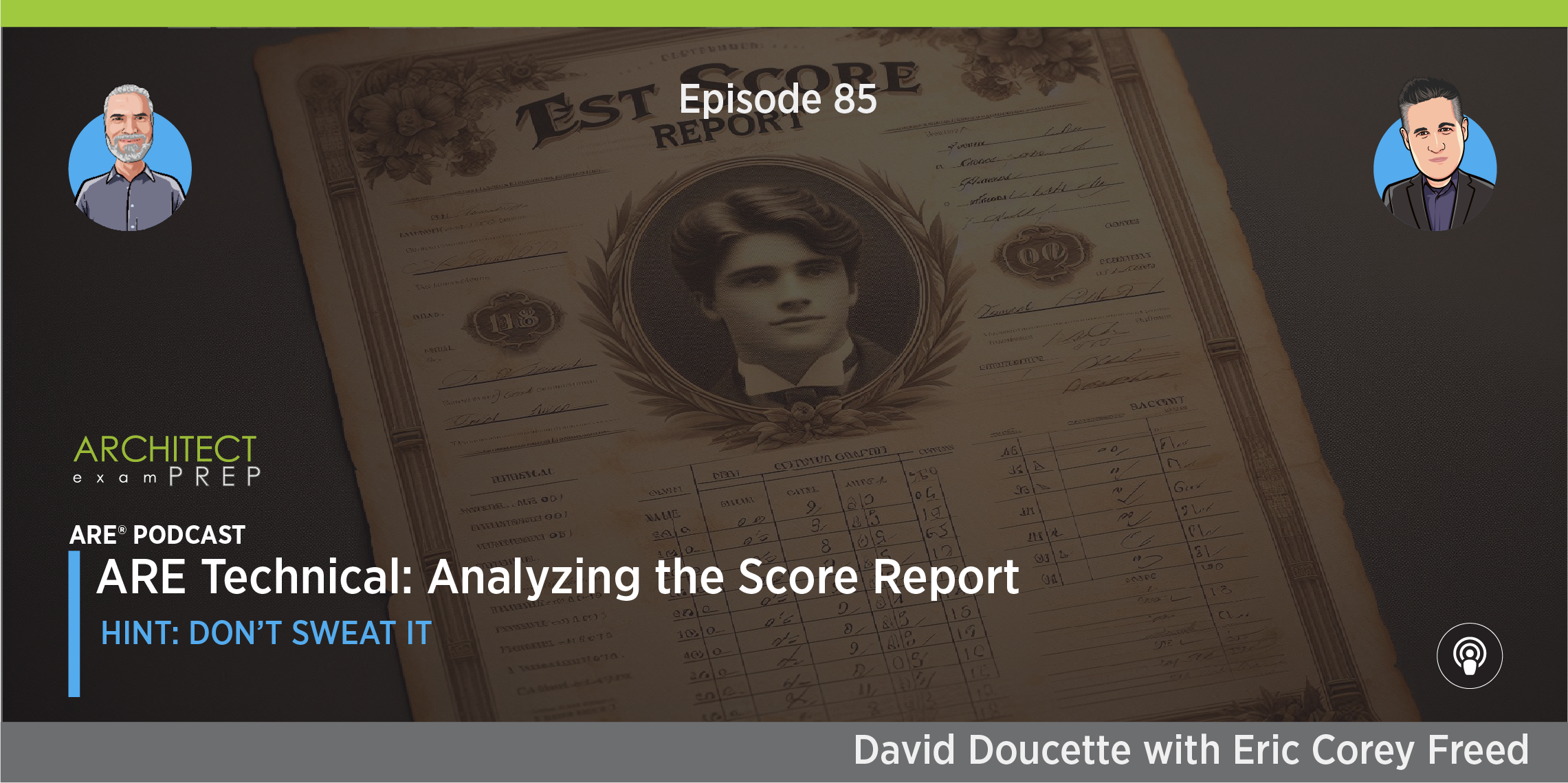
In this episode, David and Eric discuss how to realistically interpret NCARB ARE score reports without overthinking them. They explain why content area percentages and “low” scores often look worse than they are, and how weighting and test design affect what the report really means. They also share healthier retake strategies, focusing on fuzzy topics, mindset, and holistic studying rather than obsessing over every data point.
Listen to the Audio
Show Notes
- The NCARB ARE score report is vague and often over‑interpreted by candidates.
- Its only real purpose: lightly point you toward weak content areas after a fail—not to precisely diagnose everything that went wrong.
How Score Reports Work
- Tests are divided into content areas/modules, but:
- There is one overall cut score for the exam, not for each module.
- You do not need to “pass” every content area to pass the exam.
- Content areas are weighted very differently:
- Example (PDD):
- Content Area 1 ~ 37% of the test (~37 questions on a 100‑question exam)
- Content Area 5 ~ 2–8% (as few as 2 questions)
- So getting 100% in a tiny area doesn’t mean much; missing a lot in a big area matters more.
- Example (PDD):
Common Misinterpretations
- Candidates often:
- Lay out multiple reports like a detective wall, trying to decode patterns that aren’t really there.
- Think: “I got 40%, I need 80%, I’m only halfway there.”
- In reality, that might mean they were only ~10 questions away from passing.
- Believe online calculators that say, “You missed by 1 question,” which Eric says is mathematically almost never true—most are off by 5–15 questions, still very close, but not “one.”
Two Main Score Report Scenarios
- Low in one content area
- This is actually good news:
- You were close to passing.
- You likely just need to tighten knowledge in that specific area.
- Use the report as a pointer: “Study more in this content area,” not as a judgment of your overall ability.
- This is actually good news:
- Low across the board
- Usually not about content gaps in one topic.
- More about test behavior:
- Overthinking, second‑guessing, misreading questions
- Rushing or running out of time
- Not picking up clues in the scenarios
- Many candidates feel like they “bombed it,” but Eric often finds they’re still only around 10–15 questions away.
Flip‑Flopping Scores (Multiple Attempts)
- After 3+ attempts, candidates often see:
- Content areas that were strong become weak, and vice versa.
- Over many attempts, they’ve “passed” every section at some point—just never all in the same sitting.
- This indicates:
- They’re capable of passing.
- But they’re now fighting their past attempts, changing answers based on what they did last time rather than calmly applying standard of care and good reasoning.
- Eric’s coaching focuses on:
- Mindset, test‑taking biases, and a “standard of care” mental model to get out of their own way.
How (and How Not) to Use the Score Report
Good uses:
- Spend a few minutes with it:
- Note if one or two areas are clearly weaker.
- Let that inform where to get a bit more clarity.
- Pair it with your own reflection:
- Ask: Was I rushing? Misreading? Did I run out of time? Was I confused by the question wording?
Bad / unhelpful uses:
- Over‑analyzing multiple reports, building big collages and trying to decode hidden meanings.
- Letting the “% correct” vs “passing candidate %” convince you you’re farther from passing than you really are.
- Using it as an emotional verdict: “I bombed, I don’t know anything.”
Better Strategy After a Fail
- Write down your “fuzzy topics” immediately after the exam:
- Any concept where you thought, “I’m not totally sure.”
- That list becomes your real study roadmap.
- Study holistically, not just one tiny module:
- Yes, give extra attention to weaker content areas.
- But keep reviewing all modules, because questions are integrated and pulled randomly from large banks.
- If you ran out of time and left many blanks:
- The score report is basically useless in that situation—it’s mostly reflecting unanswered questions, not your knowledge.
Coaching / Tools Mentioned
- Eric has a score report tool in the Platinum coaching program:
- Takes the NCARB percentages from a score report.
- Estimates how many questions away from passing a candidate likely was.
- He also does five free coaching calls per day to:
- Interpret reports.
- Re‑frame how close people actually are.
- Build a realistic study and mindset plan.
- Their coaching provides a daily study plan, organized by content areas, to remove overthinking about “what to do next.”
Big Takeaways
- The score report is not an oracle (and not the Grim Reaper either).
- It’s a blunt, limited tool:
- Use it quickly, unemotionally.
- Let it lightly guide you, then move on to studying and retaking.
- Practically, a failing score report mostly just means:
You need to take the exam again, with slightly better content clarity and a much better test‑taking mindset.
Please Subscribe
Receive automatic updates when you subscribe below!



Please rate us on iTunes!
If you enjoyed the show, please rate it on iTunes and write a review. It would really help us spread the word about the ARE Podcast. Thanks!